JUST ANDERSEN: BETWEEN WEIGHT AND LIGHT
A vessel that seems heavier than its size suggests. A dark metal surface that gives an ordinary object the presence of sculpture. In the work of Danish designer Just Andersen (1884–1943), familiar forms acquire unexpected qualities. Moving between classical traditions and modern design, he explored how proportion, materia
From Greenland to Copenhagen
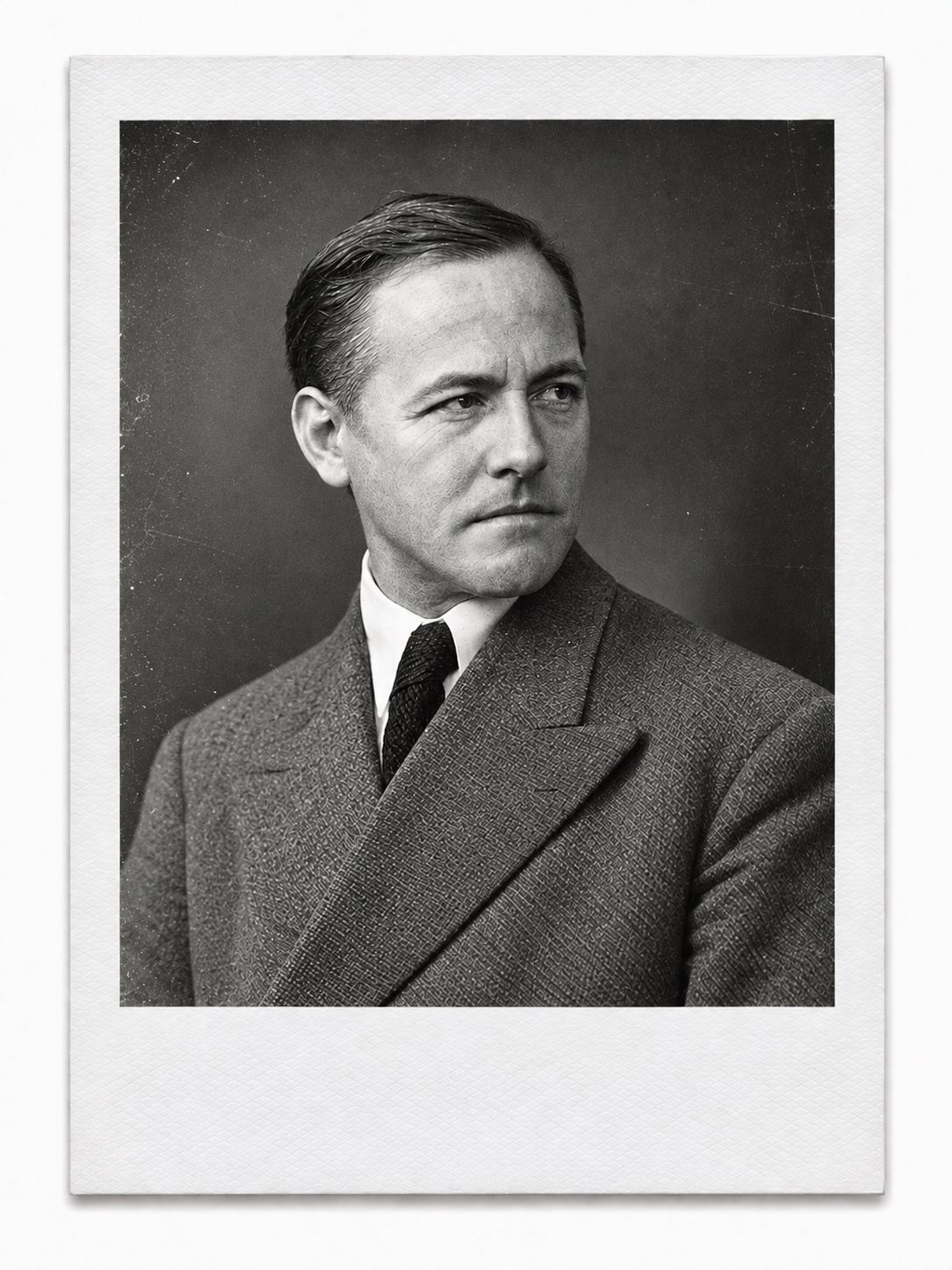
Just Andersen was born in 1884 in Godhavn, now Qeqertarsuaq, on Greenland’s Disko Island, where his father served as an inspector in North Greenland. He spent the first decade of his life there before the family moved to Denmark.
His education moved between disciplines. Andersen trained as a decorative sculptor and later studied painting and sculpture at institutions including the Royal Danish Academy of Fine Arts and the School of Danish Arts and Crafts. Early contact with the circle around Mogens Ballin introduced him to a Danish tradition in which design was closely tied to materials and craftsmanship.
Andersen worked across painting, sculpture, jewellery and metalwork, but metal offered a particularly broad field for experimentation. After supplying designs to established Copenhagen silversmiths, including A. Michelsen and P. Hertz, he established his own firm in 1918.
Together with his wife and collaborator Alba Andersen, a trained chaser, he produced jewellery and silverware alongside vessels, candlesticks, lamps and sculptural figures. Working in precious and more commonplace metals, Andersen developed a practice that moved freely between decorative art, sculpture and objects for everyday use.
Between Classicism and Modernism
Andersen began working at a moment when Danish design was reconsidering its relationship to the past. During the 1920s, classicism offered one route away from the elaborate historicism of the previous century. Symmetry, measured proportions and clearly defined volumes made it possible to simplify without abandoning history altogether.
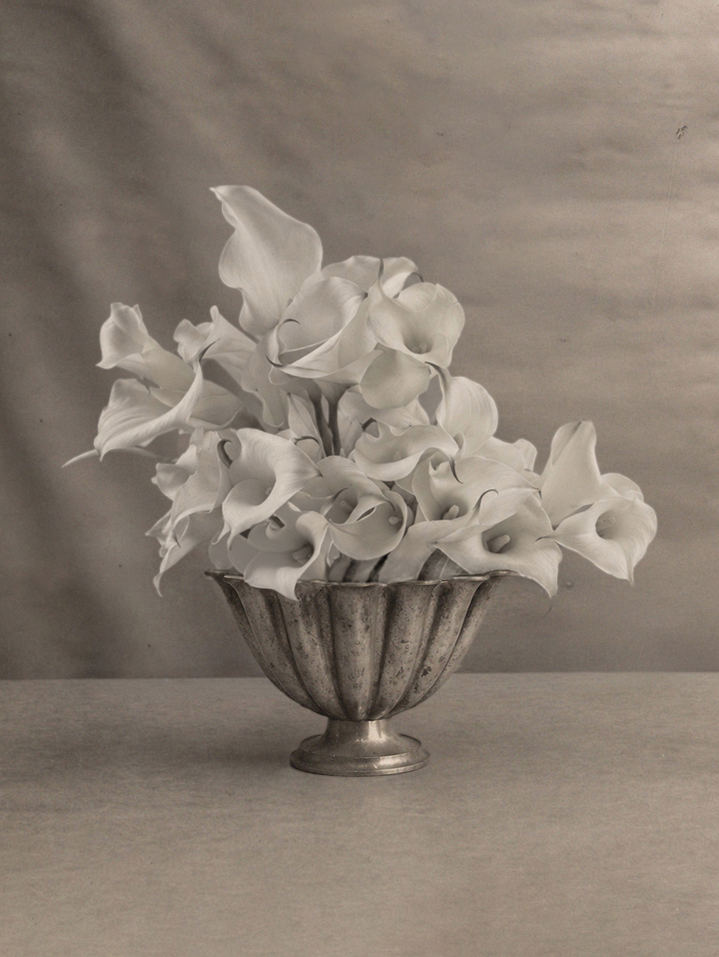
Andersen seemed particularly comfortable in this in-between territory. Classical references remained, but they were gradually condensed. A column became a stem. The profile of an ancient vessel became a relationship between foot, body and rim. Fluting remained too, although increasingly it worked less as ornament than as a way of dividing a surface and directing light across it.
As functionalism gained ground in Denmark during the late 1920s and 1930s, Andersen’s designs grew quieter. Decoration receded, but rarely vanished completely. A decorative band might become a series of ribs; elsewhere, proportion itself became enough.
This was modernism through editing rather than erasure. Andersen did not need to abandon historical forms. He simply pared them back, gradually stripping away ornament and excess until a new visual language began to take shape.

Shaping Weight
Look closely at Andersen’s work and its apparent simplicity begins to feel carefully constructed. A broad vessel balances on a narrow foot. A rounded body meets a sharply defined neck. A slender stem supports a disproportionately substantial candle cup. Small adjustments give otherwise familiar shapes an unexpected presence.
His training as a decorative sculptor is particularly visible here. Volumes swell and contract; profiles accelerate and slow; transitions between base, body and rim are rarely neutral.
Circles, cylinders, spheres and elongated curves recur throughout his work, but Andersen seldom treated geometry as an end in itself. A base made slightly narrower than expected could make a body appear heavier. A low centre of gravity could give a small vessel an almost architectural stability. A sharply turned rim could bring an otherwise continuous curve to an abrupt stop.
These are minor interventions, but they change how a piece is read. Once these relationships were resolved, there was often very little left to add.
A Metal of His Own
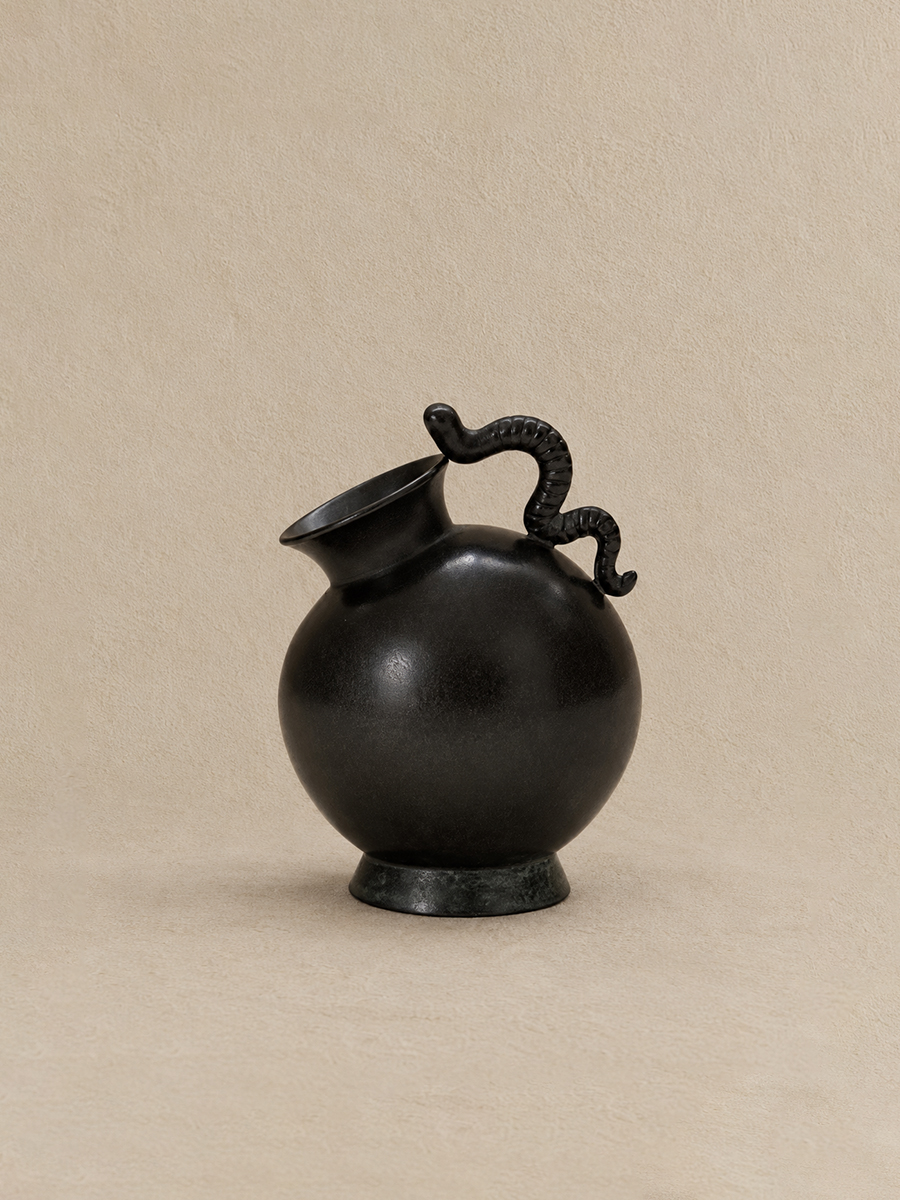
Perhaps the clearest expression of Andersen’s interest in material was Disko metal, the alloy he named after the Greenlandic island of his childhood. Used for vases, bowls, candlesticks, lamps and figures, it became one of the most recognizable signatures of his workshop.
Its dark finish behaved very differently from polished silver. Where silver reflects and fragments its surroundings, Disko metal absorbs the gaze, drawing attention back to the form itself. Silhouettes sharpen, curves acquire greater weight, and ridges emerge and recede as light moves across the surface.
The effect could be particularly striking at a small scale. A modest vessel might acquire an unexpected sense of mass through little more than a dark finish, a weighted base and carefully compressed proportions.
The choice of metal, in other words, was never simply a matter of finish. It changed the way the whole was understood.
Light Across a Surface
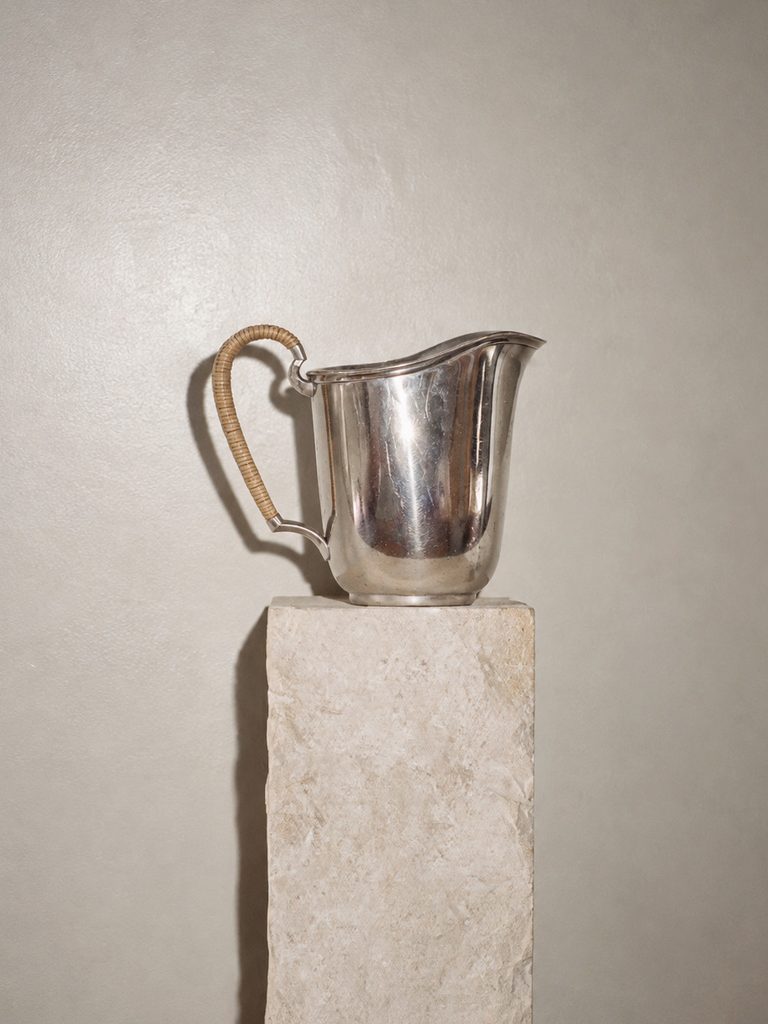
This relationship between material and light runs throughout Andersen’s work.While silver sharpened reflections, bronze deepened recesses and pewter softened the transition between light and shadow. Each metal revealed form differently.
Texture offered another means of controlling this effect. Ribbing broke light into intervals; a continuous curve allowed it to travel uninterrupted around a vessel. Even a narrow foot could change its visual weight by introducing a shadow beneath it, separating its mass from the plane below.
Handles, rims and bases belonged to the same visual system. What was necessary for construction also became a way of directing the eye.

The Memory of Material
By the 1920s and 1930s, Andersen’s work was circulating beyond Denmark, encompassing jewellery, hollowware, lighting, vessels and figures. He died in 1943, after which the company bearing his name continued under Alba Andersen.
His career coincided with a period in which Danish design was moving from classicism towards functionalism and, eventually, what would become internationally recognised as Danish modernism. Andersen sits somewhere within that transition, but never entirely on one side of it. Classical order remains even as his designs become simpler. Ornament survives where it contributes to structure or texture. Pewter and other modest metals receive the same attention as silver.
Even Disko metal carries something of this relationship between past and present. Its name looked back to the landscape of Andersen’s childhood, while the pieces made from it increasingly belonged to a new visual language.
Andersen’s broader achievement lay in what he could extract from the materials themselves. Even at a modest scale, a vessel or candlestick could establish a remarkable sense of weight, balance and rhythm with very little ornament.
His work suggests that modernism did not always arrive through a dramatic rejection of what came before. Sometimes the change was quieter. What remained was not history erased, but history compressed into form.
Sources & Further Reading
Dansk Biografisk Leksikon — Lex. Just Andersen. Biographical account of Andersen’s education, career, metalwork, and company.
Weilbachs Kunstnerleksikon — Lex. Just Andersen. Biographical and art-historical reference on Andersen as sculptor and silversmith, including his relationship to modern Danish Neoclassicism and functionalism.
Lex — Danmarks Nationalleksikon. Just Andersen. Overview of Andersen’s work in pewter, bronze, and Disko metal and his position within Danish classicizing functionalism.
The British Museum. Just Andersen. Collection and biographical information documenting Andersen’s work as a Danish metalworker, designer, sculptor, and medallist.
Just Andersen Selskabet. Just Andersen 1884–1943. Biographical material and documentation relating to Andersen, Alba Andersen, the workshop, and its production.
Lex — Danmarks Nationalleksikon. Danmark — kunsthåndværk og design. Historical overview of Danish design and the transition from 1920s classicism toward functionalism.
Thage, Jacob. Danske Smykker / Danish Jewelry. Reference work on Danish jewellery and metalwork, including Just Andersen.
Just Andersen Selskabet. Collection and archival material relating to Just Andersen and the production of his workshop.
The British Museum. Collections relating to Just Andersen and Danish metalwork of the early 20th century.